
LogUp Buses
How LogUp buses connect the tables of a Hekate zero-knowledge proof: a multiset check as a sum of fractions, the binary-field trap, a bus of your own in Rust.
On this page
A bus proves that the messages one table sends are the messages another table answers, each exactly once, without the verifier comparing the two tables row by row. Hekate builds every bus with LogUp: each side adds up over its messages, and the sums must cancel. This page builds that check from a two-message example, shows the trap a binary field sets for it and how Hekate closes it, lists the bus shapes Hekate's API builds, and ends with a bus between two tables of your own, proved and verified in Rust.
§ Why tables need buses
A Hekate program is a set of tables, and a bus is what lets one table's answers count as another table's results.
Each table has its own height and width. A processor-style table runs one row per step, a memory table one row per access sorted by address, the Keccak chiplet 25 rows per permutation. In one shared table every part would be as tall as the tallest and as wide as all of them together, and the padding would be encoded, hashed and proven like real data. Separate tables avoid that, and raise a question a single table never had: does the memory table answer the accesses the processor made?
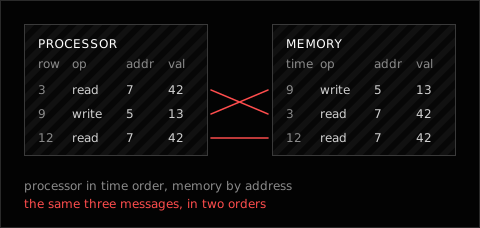
The two tables list the same events in different orders. What the bus proves is that they hold the same multiset of messages: the same messages, each the same number of times. Without it the memory table could return 99 where 13 was written and break none of its own constraints.
§ From a product to a sum
LogUp turns "the two lists hold the same messages" into one equation between two sums of fractions, the form sumcheck proves.
The classic check multiplies. For a random , drawn after both tables are committed:
Both sides are polynomials in , and two different lists give different polynomials, which agree at a random only with negligible probability. Sumcheck proves sums, though, and a product fits it badly. The logarithmic derivative turns the product into a sum, and gives LogUp its name:
Over the rational numbers, two lists hold the same messages exactly when these sums agree for every , and a random tells two different lists apart except with negligible probability. With ordinary numbers and :
sender keys     7, 5     1/17 + 1/15
answerer keys   5, 7     1/15 + 1/17     equal, in any order

answerer keys   5, 8     1/15 + 1/18     off by 1/17 − 1/18 = 1/306
To answer 8 where 7 was sent, a cheater needs keys whose fractions add up to the same total at a drawn after its tables were fixed.
§ The helper column
A constraint cannot divide, and every bus endpoint adds a committed helper column that holds the fraction of each row.
A selector marks the rows that take part in the bus: 1 on the rows that send or answer, 0 elsewhere. The helper holds , and the proof checks it by multiplying; the engine adds this check for every endpoint:
The bus check has three parts.
- On every row, : the fractions are computed honestly. The check joins the table's ZeroCheck, next to the constraints.
- Over the table, the values of add up to the endpoint's claimed sum, which sumcheck proves in the same pass. On a lookup bus each row's fraction is weighted by , which binds the two sides row by row.
- Over the program, the claimed sums of every endpoint on the bus cancel. The verifier adds them.
PIOP Protocol shows both terms in a table's sum. The helper columns of every table share one Merkle root, absorbed before any table's sumcheck draws its first challenge. Hekate once shipped it uncommitted, and a prover could fit the helper's value to a point it already knew; Three unbound values tells that story.
§ A message with many values
A message of several values becomes one key through a second challenge, , whose powers fix each value's slot:
The position decides the power. Without it, the message (address 5, value 13) and the message (address 13, value 5) would have the same key.
§ Binary fields need no signs
In a binary field every element is its own negative, and a bus needs no signs: every endpoint adds its sum the same way, and the sums on a bus must add up to zero.
Over the rationals, the check is "sender minus answerer equals zero", and each side has to know its sign. In GF(2^128), and subtracting is adding: a message sent once and answered once contributes the same fraction twice, and the pair cancels. The verifier adds the claimed sums of every endpoint with the same bus id and checks for zero; with zero knowledge on, the outer argument makes the same check on the masked sums. A bus with three endpoints, two asking and one answering, needs nothing more. The private payment in Your First ZK Program runs one.
§ The trap: equal keys cancel
On a permutation bus the same rule cancels two equal keys on one side, and such a bus is sound only when a key that carries data cannot appear twice on one side.
Fractions cancel whenever their keys are equal, whichever table they come from. A cheater who sends one message twice gets two equal fractions, which cancel each other, and the answering table never has to answer either.
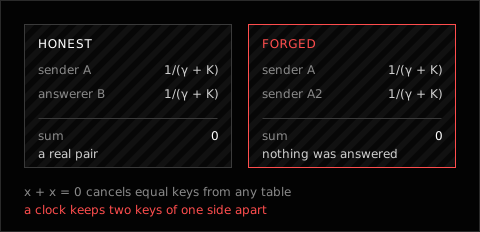
In a field of odd characteristic the duplicate shows, since is not zero. In GF(2^128) it vanishes. The fix is to make two rows of one side unable to share a key, with a slot whose value differs on every row: a clock.
Hekate's post-quantum pipelines use the same rule on purpose. A slot with nothing to carry emits a constant key that no data key equals, and the schedule keeps the count of those keys even, which cancels them.
§ Clocks
Every bus in Hekate carries something that keeps two messages of one side from cancelling, and the kind of bus decides what.
| Kind | Messages stay apart because | Used by |
|---|---|---|
| Ordered | the verifier labels the t-th message of each side | every call-and-return service |
| Lookup | an eq factor binds row i of one table to row i of the other | ROM fetches |
| Raw, with a clock | the requester's row number, and a timestamp the answering table sorts | RAM |
| Waivered | labels and indices the program keeps unique | the internal buses of the post-quantum tables |
The row number of a requester is free: the verifier computes it from the position, and no column holds it. RAM answers
in address order, and its clock is a committed timestamp; its sort constraints force (address, time) to increase
strictly, and its endpoint carries a waiver that cites them. The post-quantum tables key their internal buses by labels
and indices, and their waivers cite where the program makes each key unique. A waiver has to
start with see and run to at least 32 characters, and by convention it names the file of the constraint it relies
on. The engine checks its form, and an auditor checks its argument.
§ Calls that span two rows
Distinct keys give every message one partner. A call whose input and output sit on different rows needs more: both halves must find their partners in the same call.
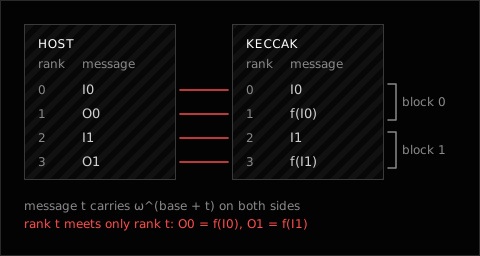
A Keccak call spans two rows of its host, the input state on one and the output on a later one, and the chiplet answers with the two ends of one 25-row block. While the chiplet wrote its own clock, a committed column that no constraint read, nothing tied a block to a call. The forgery that Hekate's own postmortem ran pairs the halves across calls:
 host emits                       chiplet emits
 (I0,    clk 0,  input)           (I0,    REQUEST_IDX 0,  input)    block 0
 (f(I1), clk 24, output)          (f(I0), REQUEST_IDX 49, output)   block 0
 (I1,    clk 25, input)           (I1,    REQUEST_IDX 25, input)    block 1
 (f(I0), clk 49, output)          (f(I1), REQUEST_IDX 24, output)   block 1
Same multiset, every constraint satisfied, and the host's first call reads keccak-f of the second call's input.
§ Ordered buses
On an ordered bus the verifier writes the clock: the t-th message of each endpoint carries ,
and request t can meet only response t.
t counts the rows above the message where the endpoint's selector is 1, and the selector is a fixed column: the
program decides which rows send, and the verifier computes it for itself. base counts the messages before the
endpoint on its side, over the program's endpoints in a fixed order, which lets two tables share one side of a bus.
Neither side commits a clock column.
is an element of GF(2^128) whose powers work as a clock hand: and onward do not return to a mark they have passed before steps, where is the order of , 67,280,421,310,721. That is a prime factor of , which equals 274,177 times . The verifier needs the clock's extension at the sumcheck point without a pass over the rows, and the exponent rule provides it. For a selector that is 1 on every row, the clock is a product over the bits of the row number:
With one bit, rows 0 and 1 carry and , and the line through them at is , the product's one factor.
Two things stay with the program. The engine cannot see whether a host emits its requests in the order it means, or whether a circuit computes what its name says.
§ Bus shapes in the API
Hekate's API builds every bus endpoint as a PermutationCheckSpec, in one of four shapes, and an endpoint on any but
an ordered bus can also be paired. new, new_lookup, new_paired and with_clock_waiver below are its methods.
| Shape | Built with | Matches | Hekate uses it for |
|---|---|---|---|
| Ordered | a Service of kind Permutation, with an EmitRank slot | request t with response t | every call-and-return chiplet |
| Lookup | a Service of kind Lookup, or new_lookup | row i of one side with row i of the other | ROM fetches |
| Raw, with a clock | new, with a row-number Source in the key | the same multiset, in any order | RAM requests |
| Waivered | with_clock_waiver, on a spec with no clock | the same multiset; your constraints keep keys apart | RAM answers and the post-quantum internal buses |
| Paired | new_paired, with a send and a receive selector | as its kind | none of the shipped chiplets |
cx.call builds the requesting end of a Service, and cx.bus(id, spec) adds any endpoint you build yourself, the
way the range table below answers with service.respond. A chiplet that implements Air by hand returns its endpoints
from permutation_checks. A raw endpoint builds its key from Source values, such as a column (Source::Column), a
constant both sides share (Source::Const), bytes of the row number (Source::RowIndexLeBytes,
Source::RowIndexByte) or the emit rank (Source::EmitRank).
A paired endpoint, new_paired(sources, s_send, s_recv, kind), gives a table one helper column for the rows it sends
and the rows it receives, with the sum of the two selectors as its own. Your constraints must keep
s_send · s_recv = 0: a row with both at 1 adds its fraction twice, which is zero, and drops out of the bus unseen. An
ordered bus refuses paired endpoints, and a lookup bus refuses waivers.
§ What the engine checks
Circuit::compile checks the shape of every bus, and the verifier repeats the checks that soundness rests on, the
selectors and the shape of every ordered bus, before any transcript work.
- Every permutation endpoint has a clock: an emit rank, a row-index source, or a waiver in the right form.
- Every selector is a fixed column, or absent when every row takes part, and every ordered selector has a strided, segmented, periodic or sparse shape of zeros and ones. A selector the prover could fill in would let it choose which rows join the bus.
- A bus id is printable ASCII without spaces, and one bus does not mix permutation and lookup endpoints. A zero-width or look-alike character would make a second bus that balances on its own.
- The two sides of an ordered bus emit the same number of messages.
§ What a bus costs
- One committed helper column per endpoint, at 16 bytes per row, in a second Merkle tree opened at the same positions as the table.
- Two more claimed values per endpoint at the sumcheck point: the helper on this row and on the next.
- A sumcheck degree of at least 3 for the table.
- One more term in the soundness accounting: must not make a denominator zero on any row of any bus, which fails with a probability of about the number of bus rows divided by .
§ A bus of your own
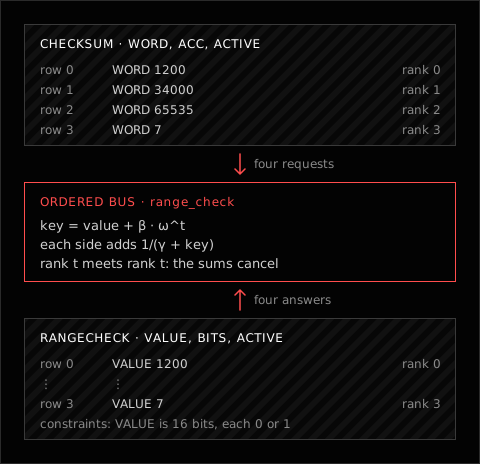
This program proves that four private 16-bit numbers have a public XOR checksum, with the range check in a table of its own that the checksum table calls over a bus.
The checksum table is the one AIR Constraints builds: WORD holds the input,
ACC the running XOR, and ACTIVE marks the four rows that do work. Its constraint xor_step makes the next ACC
this ACC XOR this WORD, and the program publishes the last ACC. The new part is a second table, RangeCheck,
which proves that every value it answers fits in 16 bits.
The program takes three files. Start from the crates in Installation and
add rand.
1use Config;
2use errors;
3use ;
4use ChipletDef;
5use ;
6use ;
7use ;
8
9pub const RANGE_BITS: usize = 16;
10
11pub type F = Block128;
12
13define_columns!
20
21define_columns!
28
29
36
37
40
41
64
65
102
103
1use crate;
2use errors;
3use ;
4use ;
5
6
23
24
1
2
3
4use ;
5use Config;
6use DefaultHasher;
7use Transcript;
8use program_id;
9use ;
10use prove;
11use preflight;
12use HekateVerifier;
13use ;
14use Error;
15use ;
16
17const LABEL: & = b"ranged-checksum";
18
19
cargo run prints checksum 32664 and the verifier accepts the proof. As on
AIR Constraints, the words themselves are
free: the proof says that some four 16-bit numbers have this checksum, and a real program binds its inputs to
something public.
- The service.
range_servicedeclares the bus once: its id, its kind and its key slots.ServiceSlot::Valuebinds a column on each side, andServiceSlot::EmitRankis the ordered clock. Both endpoints derive from it:cx.callmakes the checksum table the requester, withACTIVEas its selector, andservice.respondmakes the range table the answerer. - The range table.
RangeCheckholds a value and 16 bit columns. The commitment binds aBitcell only to a 32-bit value, andassert_booleankeeps each one 0 or 1.value_from_bitssets the value equal to the sum of the bits, bitkweighted byF::from(1u128 << k): in a binary field that sum is the bit pattern itself, and no value of 65,536 or more can be written with 16 bits. - The selectors. Both are fixed columns, 1 on the first four rows.
Circuit::compilerejects a bus whose selector the prover could fill in. - The witness. The checksum trace is the main table, and the range trace joins it through
with_chiplets, in the order the program attached its tables.
Both tables take the minimum height here, config.min_table_rows(). An attached table has a height of its own, which
the prover picks with its trace, tall enough for the calls it serves.
§ Break it
Preflight runs every check on the concrete trace and names what fails, before any proof.
Set the last word above the range, let words = [1200, 34000, 65535, 70000];, and run again. Preflight reports
PREFLIGHT: 1 constraint, 0 boundary, 0 fixed column, 0 bus and names constraint #16 of Chiplet 0,
"value_from_bits", on row 3. The bus still balances, because both tables carry 70000; the range table cannot write
70000 in 16 bits.
Restore the words, and give the range table the same four values in reverse order, with
range_trace(&[7, 65535, 34000, 1200], rows)? in main:
PREFLIGHT: 0 constraint, 0 boundary, 0 fixed column, 1 bus
  bus "range_check" [Permutation] (2 endpoints) failures: bus_imbalance
    Main: 512 rows, 4 active, product=Flat(Block128(124460125979834863771808947739898496039)), claimed_sum=Flat(Block128(70716840576298422149403034402590938984))
    Chiplet 0: 512 rows, 4 active, product=Flat(Block128(185972273115801970209389679514709175486)), claimed_sum=Flat(Block128(5841851349026147219847545936087325313))

Error: "the trace fails preflight"
Both tables hold the same four values, and the ordered bus still rejects them: the checksum table's first request meets the range table's first answer, 1200 against 7. Remove the preflight check and the prover still returns a proof, which the verifier rejects.
§ Next steps
- PIOP Protocol: where the bus terms sit in a table's sumcheck.
- Cryptographic Chiplets: the services Hekate ships, and how a program calls them.
- Your First ZK Program: three endpoints on one bus, and a payment that breaks it.
- Columns only the bus read: the forgeries that ordered buses close.